

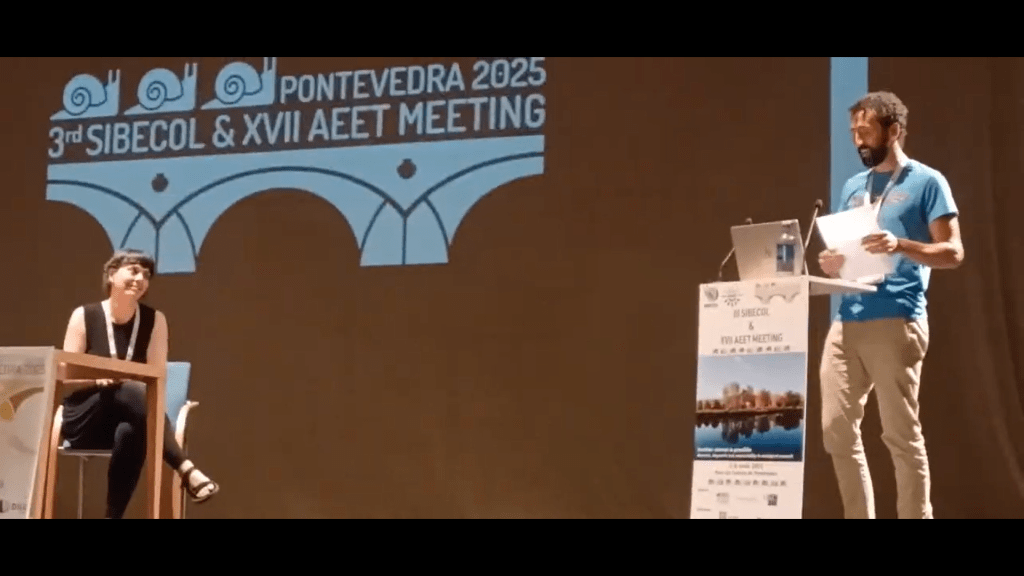
Durante el pasado congreso de la AEET-SIBECOL en Pontevedra hubo varias charlas sorpresa sobre temas transversales a la ecología. Aquí está la charla (en inglés) que prepararemos desde Ecosistemas para promover una forma de publicación más abierta y justa.
Scientific publishing is at the heart of academic life. It’s how knowledge is shared, careers are built, and progress is measured. But the system has changed — and not always for the better. Across disciplines, researchers are facing increasing pressure to publish more, faster, and in higher-impact venues. This drive for visibility often comes at the expense of quality, depth, and even well-being. We now find ourselves in a cycle that prioritizes fast science over good science, valuing metrics over meaning. And we must ask: who is really benefiting from this system?
The scientific publishing landscape has become highly concentrated. Just five major for-profit publishers now control more than 50% of all published scientific articles. These companies operate on profit margins of 20–30%, placing them in the same league as industries like pharmaceuticals, tobacco, and big tech — far above the 10% average seen in most sectors. Yet this profitable system relies on unpaid academic labor. Researchers write, peer-review, and often edit manuscripts without compensation, while publishers collect billions in revenue.
Open Access was envisioned as a way to democratize knowledge — making it freely available to all. But it has largely become another revenue stream. Many journals now charge authors Article Processing Charges (APCs) of $3,000 or more, with some top-tier journals demanding over $10,000 to make a single article publicly available. These fees create significant barriers, particularly for researchers at underfunded institutions and those in the Global South, and directly contradict the principle of equitable access to scientific knowledge. Meanwhile, many scientific societies have signed undisclosed publishing agreements or outsourced their journals to these same dominant publishers. As a result, researchers are even more distanced from decisions about access, cost, and editorial control.
One powerful strategy used by large publishers is brand extension. By launching multiple journals under well-known labels, they create an aura of prestige that draws submissions based on name recognition — not necessarily on fit or relevance. This crowds out smaller, independent, or society-led journals, even when those journals operate more transparently and uphold stronger community values.
Understanding How Change Happens
We often feel stuck. Many of us in academia are well aware of the problems within the current publishing system, yet we struggle to act on that awareness. One major barrier is how we’re evaluated — by metrics, journal impact factors, and publication counts. These standards influence our funding, job security, and recognition, making us feel trapped in a system that doesn’t reflect the values we believe science should uphold. That tension weighs on us, and it raises a critical question: how do we begin to change a system that defines our work, but no longer serves our community?
As scientists, we naturally turn to evidence when faced with complex problems. To understand how we might catalyze a societal behavioral change, we began exploring insights from behavioral science — and found that many of our assumptions don’t hold up. We often think that if people just had the facts, their behavior would shift. But facts alone rarely lead to action. For instance, knowing that May was the hottest month on record in Spain hasn’t caused major changes in our behavior. Awareness, on its own, isn’t enough.
We also tend to believe that change will come from a few powerful individuals — key opinion leaders or institutional gatekeepers. But those at the center are often the most constrained by the system. We may also assume that the solution is simply reaching more people — a larger audience, more visibility — but scale doesn’t guarantee impact, especially if it lacks real engagement.
What works is something different — and more hopeful. Change happens when we engage actively, not passively. People shift their behavior when they participate in a community that reflects shared values. Transformation tends to begin at the margins — with smaller, committed groups that experiment with new ways of doing things. And over time, connecting those efforts across the network is what starts to create real cultural shifts.
A Reason to Be Hopeful
This gives us reason to feel hopeful. Within AEET–SIBECOL, we already form a strong, cohesive community. We are involved in many aspects of scientific life — from evaluating projects and organizing conferences to managing journals and supporting peer review. We may not be central players in the global publishing scene — not yet —, but we already manage several open-access, community-driven journals: Ecosistemas, Limnetica, and Web Ecology. These are free to read and free to publish in, and they reflect a different, fairer model of scientific communication — one built on transparency, accessibility, and service.
Let’s remember that publishing began as a service created by researchers for researchers. That original purpose still lives on in our journals. Many of us have already contributed to this effort — editing, reviewing, and publishing in venues like Ecosistemas, particularly in successful monograph collections. We thank everyone who has made this possible. But now we face a new challenge: to take our support further. We need to submit our best work to fair journals, to cite them and to promote them. Especially, we call senior researchers whose position is already secure to do the first step, and start the snowball effect so early-career researchers can see these outlets as respected and valuable outlets for their science.
We know that systemic change takes time. It will not happen overnight, and it will not come from the top down. But we don’t need to wait for someone else to start. Change begins with us — through intentional, collective action. By choosing to support the journals and practices that reflect our values, we can begin to shift the culture of publishing toward something more inclusive, ethical, and sustainable.
Let’s use the tools and platforms we already have.
Let’s build on the strengths of our community.
And together, let’s reclaim publishing as a space that serves science — not profit.
Take a look to the photographs of the AEET-SIBECOL congress in Pontevedra here!
Ecosistemas Editorial Board
 blogaeet.org